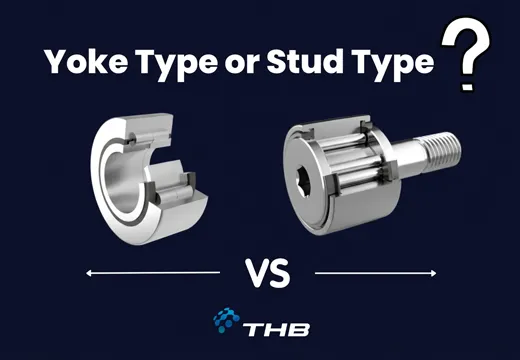
Note on Terminology
The industry uses multiple naming conventions for these bearings. INA (Schaeffler) classifies both as "Track Rollers" (Yoke Type / Stud Type); IKO refers to them as "Roller Followers" and "Cam Followers" respectively; McGill uses the trade name "CAMROL®." This article follows the INA structural classification as the primary framework.
1. A Structural Difference: Integrated Stud vs. Separate Pin
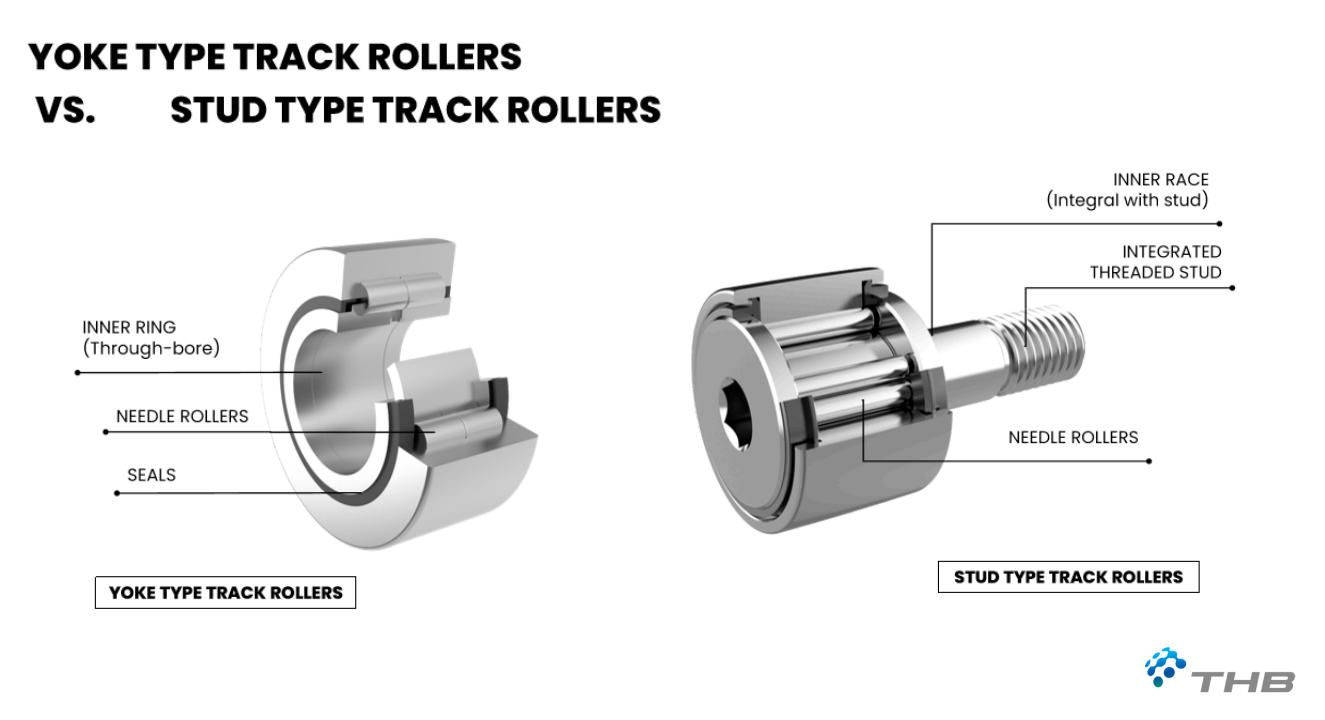
One distinction lies in whether the mounting axis is an integral part of the bearing or provided externally.
2. Yoke Type Track Rollers: High Rigidity through Dual Support
A Yoke Type roller is mounted on a separate pin. Because it is not permanently attached to a stud, the engineer can choose to support the pin at one end or both ends (clevis mounting).
When support on both sides is used, bending moments are significantly reduced, allowing the bearing to reach its full radial load capacity. This is the most efficient arrangement for heavy-load applications.
Typical applications:
3. Stud Type Track Rollers: Compact and Easy to Install
The Stud Type roller simplifies the design by eliminating the need for a separate shaft. It is a ready-to-mount unit ideal for applications where space is limited or where a cantilevered mounting is necessary.
Typical applications:
Compact spaces: When space constraints make it difficult to accommodate a separately supported shaft.
Cam mechanisms: Well suited for following cam profiles or guided tracks.
Maintenance accessibility: The integrated stud design can simplify replacement where mounting point access is unobstructed. However, actual maintenance convenience depends primarily on machine layout and access conditions.
4. Technical Comparison
Feature | Yoke Type | Stud Type |
Axis Source | Separate Pin/Shaft | Integrated Stud |
Mounting Type | Clevis (Supported both sides) | Cantilever (Single end) |
System Rigidity | High (Minimized bending) | Limited by stud bending |
Installation | More complex (Requires pin/circlips) | Simplified (Bolt-on) |
Adjustability | Fixed by pin location | Eccentric versions available |
Summary
The structural distinction between Yoke Type and Stud Type track rollers is straightforward: one relies on a separate pin controlled by the designer; the other features an integral stud as part of the product.
Each approach carries its own set of design trade-offs regarding stiffness, space, and mounting simplicity. Selecting the right type begins with understanding these structural fundamentals—and then evaluating how they interact with the unique demands of your machine design.
A Note on Bearing Selection: Framework Thinking vs. Engineering Judgment
The comparisons presented in this article are intended to help build a conceptual framework — not to serve as a direct selection guide.
Bearing performance is a system outcome. The same bearing type can perform reliably in one application and fail prematurely in another — not because the bearing changed, but because the surrounding conditions did. Factors such as actual load magnitude and direction, dynamic vs. static loading, shaft and housing tolerances, misalignment, lubrication method and interval, operating temperature, duty cycle, and contamination exposure all interact in ways that cannot be captured by a general comparison table.
If you are at the stage of actual product selection, we recommend discussing your specific application conditions with a qualified engineer. A structured review of your operating parameters will help identify the appropriate bearing type and surface potential risks in mounting, lubrication, and load path design

 English